Power Plate vs Peloton vs Treadmill: What Each Tool Actually Does to Your Body
Check Today's Price
Save 25% on the Power Plate MOVE with code DSDIGITAL
This is not a "which is best" article. Peloton, treadmills, and Power Plate are different categories of stimulus. If you already own one and are wondering whether the other is worth adding, this comparison walks through the mechanism of each - cellular, neuromuscular, skeletal, and circulatory - so you can decide based on what your body is actually missing.
Updated April 2026 - 14 minute read - Written for readers who want the "why" before the "buy."
The short version (for skimmers)
Treadmills and Peloton build cardiovascular endurance through voluntary, rhythmic muscle contractions. They are excellent at training the heart, lungs, and aerobic energy systems.
Power Plate (whole-body vibration) drives 25-50 involuntary mechanical contractions per second through muscle, fascia, and bone. The dominant stimulus is mechanical deformation and reflexive neuromuscular activation, not cardiovascular load.
These are complementary, not competing. The Power Plate does things a treadmill cannot - bone signaling at frequency, deep fascial loading, rapid nitric oxide release - and a treadmill does things a Power Plate cannot, like sustained VO2max work.
1. The Mechanism: Voluntary Contraction vs Mechanical Deformation
Treadmill running and Peloton cycling rely on voluntary contraction. Your brain sends a signal, motor units fire in a predictable, rhythmic pattern, and the working muscle shortens against load. This is the foundation of cardiovascular fitness - it trains the heart to pump more blood per beat and the mitochondria to use oxygen more efficiently.
Whole-body vibration works on a different principle. When you stand on a Power Plate at 30-40 Hz, the platform oscillates 30 to 40 times per second. Your nervous system responds with a stretch reflex - a tiny, involuntary muscle contraction triggered each time the platform changes direction. Across a 60-second set you accumulate tens of thousands of reflexive contractions. That is a stimulus density no voluntary exercise can match.
The downstream effects are mechanically driven, not metabolically driven. Cellular deformation, fascial stretch-recoil, and high-frequency loading on bone are not byproducts of cardio - they are specific outputs of vibration. For a deeper read on the underlying physiology, see our Science of Whole-Body Vibration page.
2. Side-by-Side: What Each Tool Trains
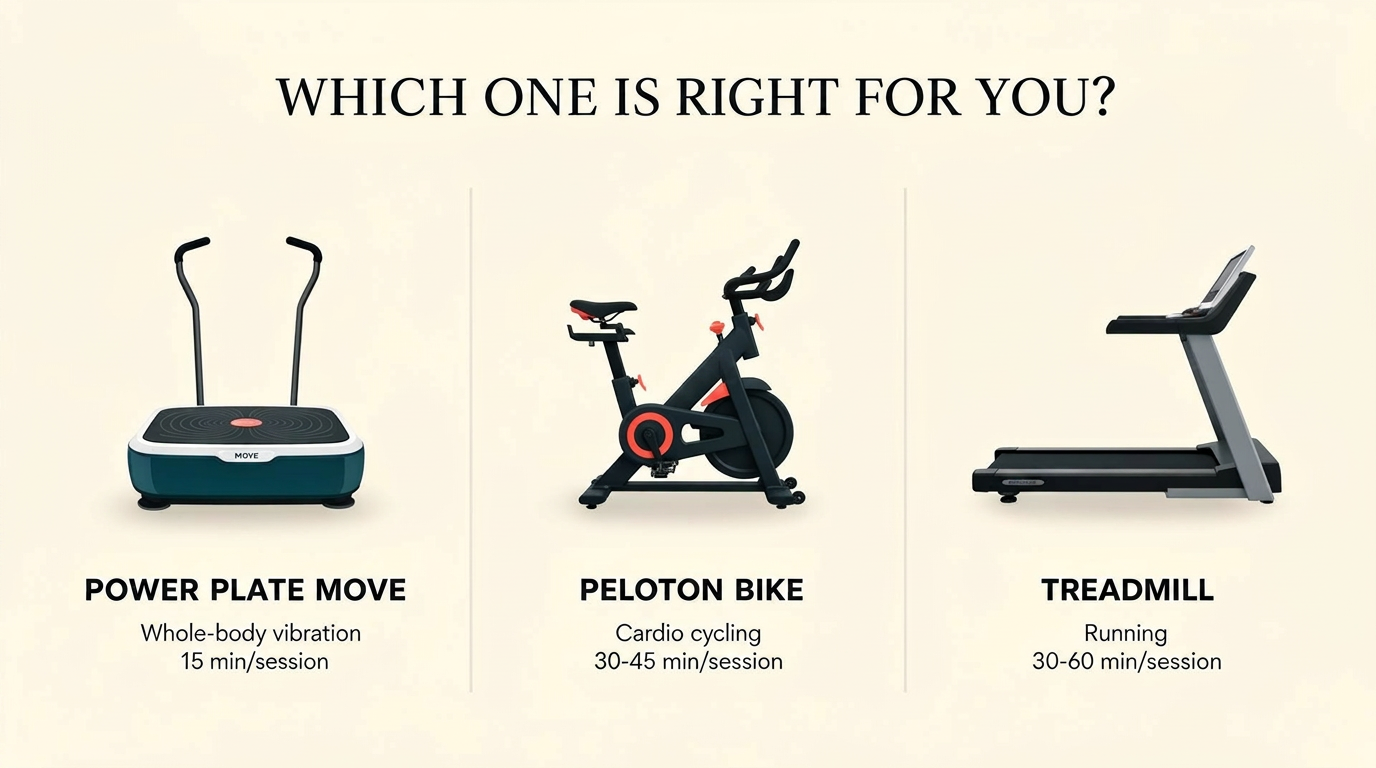
| Mechanism | Treadmill | Peloton (Bike) | Power Plate |
|---|---|---|---|
| Primary stimulus | Voluntary contraction, ground impact | Voluntary contraction, no impact | Reflexive contraction, mechanical vibration |
| Contractions per minute | ~150-180 (cadence) | ~80-110 (RPM) | 1,800-2,400 (30-40 Hz) |
| Cardiovascular load | High | High | Low to moderate |
| Bone-stimulating signal | Moderate (impact-based) | Minimal | High (high-frequency loading) |
| Joint impact | High | Low | Low |
| Neuromuscular recruitment | Moderate | Moderate | High (reflexive) |
| Time efficiency | 30-60 min sessions | 30-45 min sessions | 10-15 min sessions |
| Best for | VO2max, endurance, calorie burn | VO2max, low-impact cardio | Bone density, recovery, neuromuscular activation, circulation |
The point of this table is not to declare a winner. It is to show that the columns measure different categories of work. A treadmill that "wins" cardiovascular load is supposed to. A Power Plate that "wins" reflexive contractions is supposed to.
3. Cellular Activation: Where Vibration Does Something Cardio Does Not
The most interesting research on whole-body vibration is not about calories burned - it is about what happens inside the cell when tissue is mechanically deformed thousands of times per minute. Three pathways stand out:
- Mitochondrial signaling. Rapid ATP turnover during reflexive contraction sends a fatigue signal to the cell that promotes mitochondrial biogenesis - the same long-term adaptation that endurance training drives, but achieved through mechanical rather than metabolic stress.
- Nitric oxide release. Vibration creates endothelial shear stress within seconds, triggering a rapid burst of nitric oxide that dilates blood vessels. Cycling and running also raise nitric oxide, but the onset from vibration is faster and the local effect on stiff, under-perfused tissue is more pronounced.
- Stem-cell recruitment. High-frequency mechanical loading has been shown to recruit muscle satellite cells and bone marrow-derived mesenchymal stem cells into local repair processes. This is downstream of mechanical deformation, which is why treadmill and bike work do not produce a comparable signal.
None of this makes vibration "better" than cardio. It makes it different. If your training stack is missing mechanical deformation, no amount of additional Peloton time will fill that gap.
4. The Bone Conversation: Why Cycling Is Not Enough
Cycling is famously bad for bone density. It is non-impact, non-loading, and rides parallel to the gravity vector that bones actually need to feel. This is a known issue in elite cyclists, who frequently present with osteopenia despite extreme cardiovascular fitness.
Treadmill running improves on this through ground reaction force, but the loading is monotonous and concentrated in the lower body. For people who cannot tolerate impact - the post-menopausal population, post-surgical recovery, joint replacement patients - treadmill loading is often off the table entirely.
Whole-body vibration produces high-frequency mechanical stress on osteocytes (the cells that govern bone remodeling) without requiring impact. This is why vibration has been studied extensively for osteoporosis and why protocols exist for clinical populations. Our bone density guidewalks through the specific frequency, amplitude, and session structure used in published trials.
If you Peloton five days a week and your DEXA scan is trending the wrong way, vibration is the most evidence-supported addition you can make without changing your cardio routine.
5. Recovery and Circulation: The Underrated Use Case
Most Power Plate owners we have interviewed do not use it as a replacement for cardio. They use it as a recovery and pre-activation tool wrapped around the cardio they were already doing.
A typical pattern looks like this: 5 minutes of vibration before a Peloton ride to warm up the nervous system, improve range of motion, and prime the legs. Then the ride. Then 5 to 10 minutes of vibration with stretching afterward to flush metabolites, increase lymphatic return, and reduce next-day stiffness.
This is the use case that justifies owning both. A treadmill or Peloton trains the cardiovascular system. A Power Plate makes the body that uses them work better and recover faster. Our morning lymph activation protocol is a 10-minute routine that demonstrates the recovery use case in detail.
6. Who Should Add What
If you only do cardio
Add vibration. You are likely under-stimulating bone, fascia, and reflexive neuromuscular pathways. A 10-minute Power Plate session three times a week is the highest-ROI addition you can make.
If you only do strength
Add a Peloton or treadmill for cardiovascular and mitochondrial work. Vibration alone will not train your heart or aerobic capacity.
If you have joint pain
Vibration first, cycling second, treadmill last. See our pain relief guide for protocols specifically designed for sensitive joints.
What Power Plate is not good for
Honest limitations - because the research-oriented buyer wants both sides.
- It will not train your VO2max. If your goal is endurance racing, keep the bike or treadmill central.
- It will not produce sustained calorie burn comparable to a 45-minute Peloton class.
- It is not a cardiovascular stress test. People with uncontrolled hypertension, recent thrombosis, or active retinal disease should consult a clinician before use.
- It will not replace progressive resistance training for hypertrophy. It complements it.
If this matches how you think about your training
The Power Plate MOVE is the home model we recommend for most readers adding vibration to an existing cardio or strength practice. Use code DSDIGITAL for 25% off direct from Power Plate.
See the MOVE on Power Plate.comAffiliate link. We earn a commission at no extra cost to you. Read our disclosure policy.
Related reading for the research-oriented buyer
The Science of Whole-Body Vibration
Studies, mechanisms, and clinical applications.
Power Plate MOVE vs Budget Plates
Why amplitude, frequency, and tri-planar motion actually matter.
Vibration for Bone Density
Protocols used in published osteoporosis research.
Is the Power Plate MOVE Worth It?
Long-form ROI analysis with cost-per-use math.
Frequently Asked Questions
⚠️ Important: This is educational content, not medical advice. Consult healthcare professionals before starting any new protocol, especially if you have cardiovascular conditions, neurological disorders, or are pregnant.